What Should Be a Non-Fiction Book Length?
What Should Be a Non-Fiction Book Length? Genre Word Counts Explained
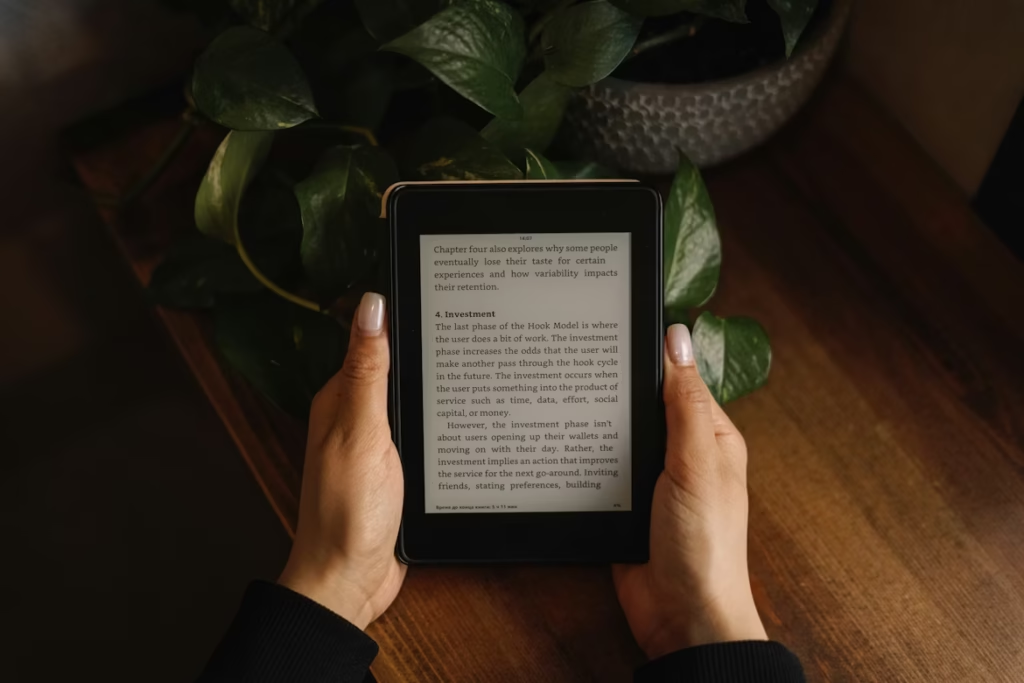
Determining the ideal nonfiction book length is one of the most common hurdles for authors in 2026. In an era where reader attention spans are competing with short-form digital content and AI-generated summaries, the “weight” of your book sends a silent signal to your audience. If a book is too short, it may be dismissed as a mere pamphlet; if it is too long, it can become a daunting commitment that stays on the nightstand rather than being finished. Finding the sweet spot for your nonfiction book length is essential to ensuring your message is both authoritative and accessible.
Why Manuscript Length is a Strategic Choice
The length of your nonfiction book is one of the primary indicators of the value the book offers. The 2026 publishing word count affects more than just the number of pages; it determines your production costs, your pricing strategy, and your level of expertise in the eyes of consumers.
- Reader Expectations: Various genres have established norms that readers use to assess how deep a book is.
- Production Costs: With a print book, more words mean more pages, which in turn increase production costs and shipping weight.
- Editing Efficiency: Professional editors charge per word; an inflated manuscript is an unnecessarily costly one.
- Perceived Authority: An overly concise business book may have a hard time justifying a higher price in a competitive market.
Word Count by Genre: Finding Your Range
Although there are no “one size fits all” rules, your nonfiction book should be approximately the length expected by readers in your specific category and that category’s publishing standards. Here are the 2026 guidelines for the most popular nonfiction categories:
Business and Leadership Books
The modern business book length has trended shorter over the last few years. Busy professionals value “all killer, no filler” content that they can consume on a single cross-country flight.
- Standard Range: 40,000 – 60,000 words.
- Goal: Bring a game-changing idea, support it with 5-10 cases, and present a clear framework.
- 2026 Trend: We’re noticing an increase in “manifesto” business books that land at a tight 30,000 words, but are filled with high-impact visual designs.
Memoirs and Biographies
Unlike the length of business books, the memoir word count allows for a little more narrative. Readers of memoirs want to be transported and to feel deeply.
- Standard Range: 60,000 – 90,000 words.
- Goal: A coherent story about your life can follow a clear emotional journey instead of a strictly ordered list of life events.
- Tip: For debut authors, staying closer to 70,000 words makes your book more salable to the traditional agents.
Self-Help and Personal Development
This genre needs to be sufficiently full to feel researched but brief enough to be practical. The nonfiction book length in the self-help genre typically balances theory with activities.
- Standard Range: 40,000 – 65,000 words.
- Goal: Lead the reader from a “pain point” to a solution with a structured, incremental approach.
Does Book Length Affect Sales?
In nonfiction word counts, there’s a complicated relationship between length and revenue. The page count is plainly stated on platforms such as Amazon, and that does have an impact on buyer psychology.
If your nonfiction book length is too short (less than 20,000 words), readers may feel like they aren’t getting a “real book” and could balk at a price above $4.99. But when you pass 40,000 words, you’re into the “normal” range, in which you are allowed to charge full market prices ($14.99 – $24.99).
Also, the average book word count for best-selling nonfiction in 2026 indicates that readers are now expecting more “deep dives” that they are not able to get from a plain AI summary. Books from 50,000 to 70,000 words do well because they’re substantial enough to be a “reference,” but they’re still easily readable.
The Editing Implications of Your Word Count
The impact of nonfiction book length on the “downstream” publishing process is another aspect that has been underestimated.
- Developmental Editing: Structural problems are far easier to address in a 50,000-word manuscript than they are in a 100,000-word manuscript.
- Copyediting Costs: Most professional editors in 2026 charge by the word. Getting rid of too many words can save you a ton of money in production.
- Layout and Design: A longer nonfiction book length requires more complex interior formatting to ensure the text doesn’t become a “wall of words.”
At The Triage Press, we are all about “triage for the text.” Just as a doctor determines what is essential for survival, an author must determine which chapters are essential to the success of the book and which are simply fat that needs to be cut. Keeping your nonfiction book length modest will keep your core message from getting lost in the din and keep the reader engaged from cover to cover.
2026 Benchmarks: At a Glance
If you are planning your manuscript, use these general targets for your nonfiction book length goals:
- Standard Nonfiction: 50,000 – 80,000 words.
- Short Guides/How-To: 20,000 – 40,000 words.
- Narrative Nonfiction: 70,000 – 90,000 words.
- Business “Big Idea” Books: 40,000 – 60,000 words.
In the end, your nonfiction book length should be just long enough to fix a reader’s problem and not one word longer. In 2026, clarity is luxury, and the fastest way to get a 5-star review is to respect the time of the reader.
Conclusion: Quality Over Quantity
Determining the appropriate nonfiction book length is a matter of balancing what is standard in the industry with what your particular message requires. In 2026, the best-selling writers are the ones who are more concise than voluminous. Don’t write any padding just so you can make a certain number of pages; concentrate on making every sentence earn its keep. When you keep to the suggested nonfiction word count ranges, you deliver a professional product that helps you gain trust and authority.
Not sure if your manuscript is the right length? At The Triage Press, we help authors evaluate their work for maximum impact and efficiency. Whether you need an editorial “triage” to cut the bloat or a strategy to expand your ideas for better market positioning, our team is here to guide you. Contact us today to see how we can turn your manuscript into a polished, professional book that sells!
Frequently Asked Questions (FAQs)
Ready to publish With Us?
At The Triage Press, we specialize in offering comprehensive self-publishing services tailored to authors, businesses, and professionals in the United States and globally. Whether you’re looking to publish your book on Amazon Kindle, need expert eBook formatting, or require professional ghostwriting services, our team provides the expert support you need to successfully navigate the publishing process.
© 2026, The Triage Press. All rights reserved.